

This is a dynamic article and the content of it gets updated and changed based on my learnings.
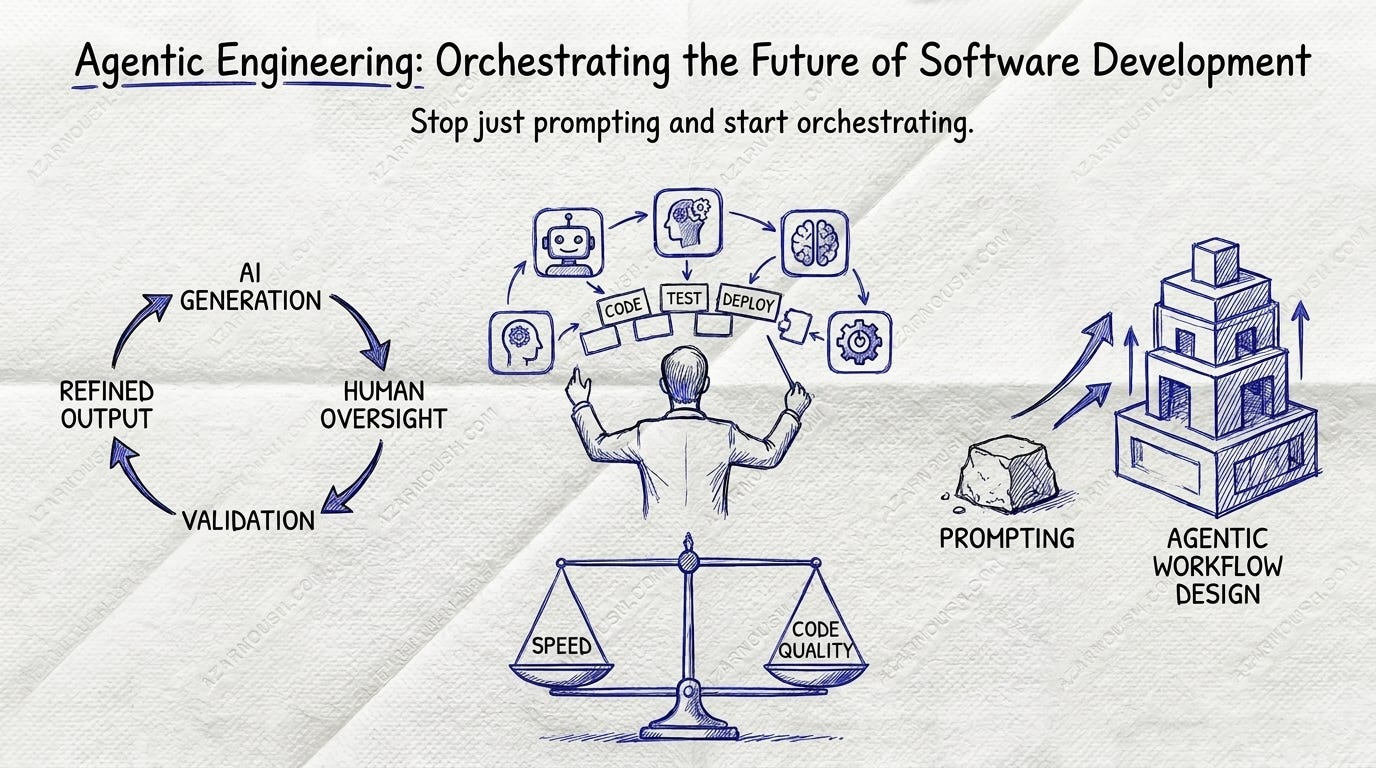
Agentic engineering is a software development practice where an orchestration of AI agents writes code while the human developer oversees, validates, and guides the output — maintaining human-in-the-loop throughout. It requires genuine expertise in designing agentic workflows, not just prompting, ensuring code quality is never sacrificed for speed.
— base on Andrej Karpathy 2026
#1 - How to Learn Agentic Engineering
Pick a stack you don’t know. If you can ship a real project with it, leaning on agents instead of your own expertise, you’ve figured out how to put agents to work. That’s the job.
Why this matters
On a familiar stack, you’ll catch yourself telling the agent how to implement things. That’s the wrong instinct. An unfamiliar stack kills it by force — you have no choice but to focus on what to build and why, and let the agent figure out the how.
Things to watch for
Engineering principles don’t change because an agent wrote the code — apply them the same way you always have
You own what gets shipped, full stop
Know when to take the wheel; security calls, architectural decisions, and subtle failures need your judgement, even when you don’t know the stack cold
#2 - Do not aim for a single shot
Resist the urge to get everything done in one go. Design for multiple shots — and more importantly, many automated shots. The real payoff comes when you can tell an agent implement ticket #7 and it spins up a fleet of agents, each handling a focused piece of the work across multiple iterations.
Why this matters
Single-shotting pulls you in one of two directions: proprietary tools like Cursor or Claude Code where you’re on their subscription, their rules, their pace — or heavy reasoning models because you need the best chance of getting it right first time. Both get expensive fast. Designing for multiple automated attempts lets you use lighter, cheaper models and stay in control of your own stack.
Things to watch for
Any process you run should be repeatable without proportionally repeating the effort
Break larger tasks down both horizontally (parallel workstreams) and vertically (sequential subtasks)