

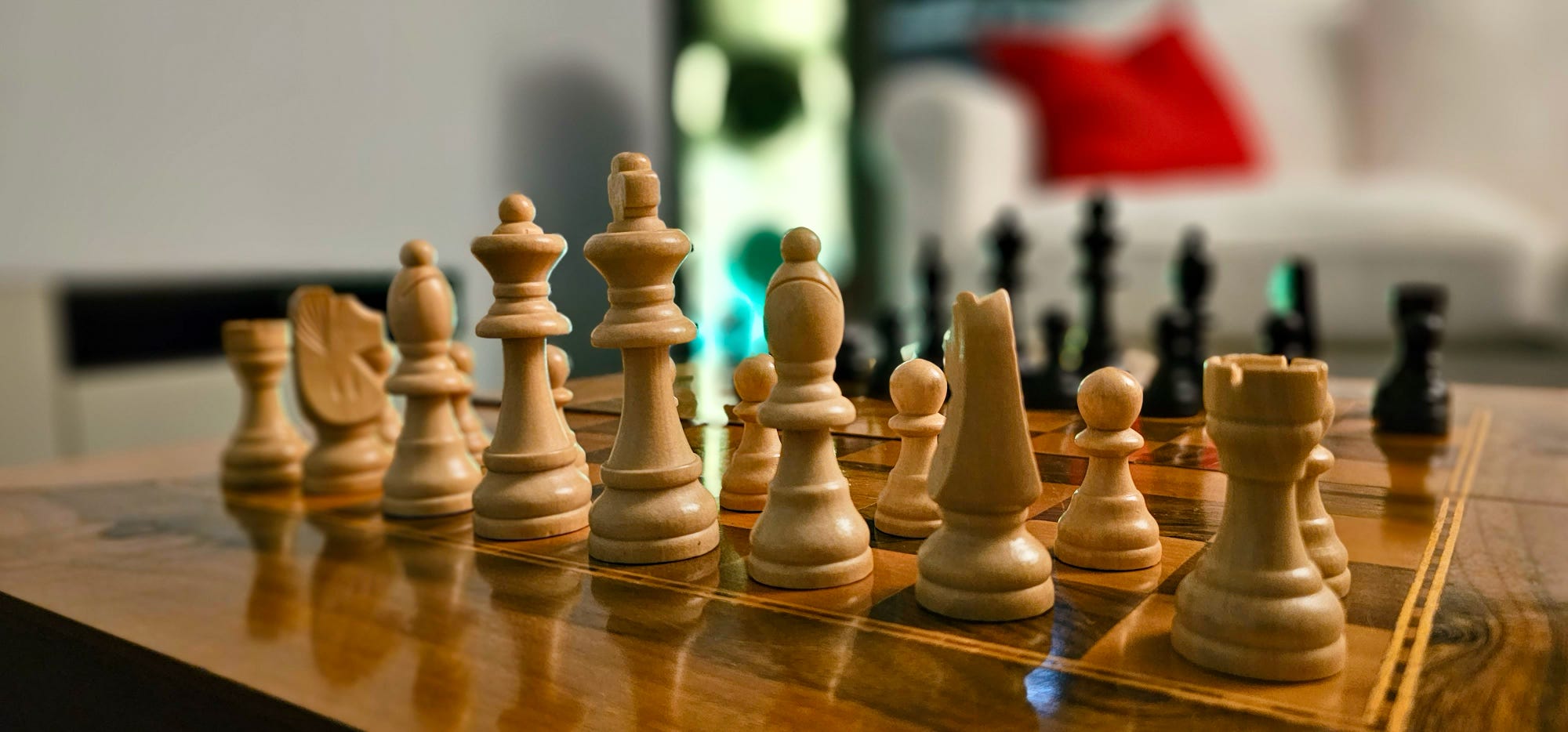
For a full year, I played at least one game of chess every single day. No exceptions. That sounds easy until you actually try it. A year is a long time, and it is full of days that are not built for a streak - travel days with no internet, sick days when you can barely think, and sad days when the last thing you want to do is sit down at a board. During a trip to Vietnam I almost lost the streak entirely, minutes away from breaking the chain because of long travel hours, no internet, and jetlag. But I held on, and I ended up with a set of lessons that had very little to do with moving pieces, and everything to do with how I make decisions, handle pressure, and work with other people.
Here is what 365 days on the board taught me about life.
A draw is sometimes a success
We grow up treating a draw like a failure. A tie. A non-result. Proof we didn’t win. But in chess, a draw is often a genuinely good outcome, and knowing when to take it is a skill in itself.
When you are behind, clawing your way back to a draw is a quiet victory. But the more interesting case is when the position is level. That is when offering a draw becomes a weapon.
Your opponent will usually reject it. And the instant they do, the fear of losing goes to work. If you then edge slightly ahead, they start reliving the draw they turned down - the loss they could have walked away from. That regret becomes a second opponent they are fighting before the game is even decided.
Sometimes the smartest move is to lock in a good outcome instead of chasing a perfect one. And the offer itself can rattle someone who assumed you were the one who should be afraid.
The fear of losing is the real opponent
Most games are not lost on the board. They are lost in the head. There is a moment in almost every game where the position is fine but your nerves are not, and the move you play in that moment is the one that decides everything.
Playing “not to lose” is completely different from playing to win. The moment you switch, you stop making moves and start making excuses. You defend when you should attack, you trade pieces when you should hold them, and you shrink your ambition until it fits inside your fear. The strange part is that this is self-fulfilling: the more you play to avoid losing, the more you lose.
I started to notice the same pattern away from the board. The meetings where I was most afraid of looking wrong were the ones where I contributed the least - and the ones that went the worst.
Measuring your state of mind
Chess is a brutally honest mirror. Unlike most games, luck has no say in it. There are no dice, no shuffle, no cards to blame - every result comes down to skill and skill alone. The exact same position looks completely different depending on how you feel. When you are calm, you see patterns and plans. When you are rattled, you see threats everywhere and you play scared. It is not luck that changes what you see - it is your mood, and your mood is what shapes your vision and your planning.
I learned to treat my own state of mind as a variable on the board, not just the backdrop to it. Before committing to a move, I would ask myself: am I seeing this position, or am I seeing my mood? Most of my worst blunders came from answering that question wrong.
Time is the biggest enemy
Chess is decided by two forces, and the clock is the more unforgiving one. You can have the better position and still lose, because the clock does not care how good your plan is. Overthink a winning position and you run out of time - a game you should have won slips away while you hunt for a perfect move that never comes.
But the clock cuts both ways.
When you are the one in a losing position, your opponent is fighting that same clock, and one rushed move under pressure can hand the game straight back to you. So you do not give up - a bad position is only truly lost when the flag finally falls.
Managing time is managing pressure, and the same is true in work. A great strategy executed too slowly is just a missed opportunity, while an imperfect one delivered on time still gets a chance to win.
Strategy wins over material
Material is important, and being up in material will generally give you more power - that part is not in doubt. But most of the time, material is not what gives you the competitive edge.
The reason is that you can almost never fall far behind or race far ahead on material, because the moment the gap gets too big, the game is already decided. In a serious game, both players fight to keep the material roughly level. So material alone rarely wins you the game - it is the baseline, not the weapon.
What actually wins games is a strategy advantage. In my experience, if you stop obsessing over the material count and focus instead on the position - paralysing your opponent’s pieces, activating your own, winning small battles early, steering the game somewhere your opponent has not prepared for - that is a real, durable edge. It is the kind of advantage that is very hard to turn around once you have it.
That is why my favourite openings tend to sacrifice material on the second move, sometimes even the first. I am paying for the thing that actually wins games.
Resources matter, but they are rarely what separates you, because everyone who is serious has them - and a genuinely lopsided resource gap is rare, not a strategy. The real edge is in how you position yourself, where you point your energy, and whether you are the one moving first. That kind of advantage compounds, and it is much harder for someone to take away from you.
Irregular pathways
The shortest line is not always the winning line. Some of my best results came from moves that looked sideways at first - quiet repositioning, a patient maneuver, taking a route my opponent never considered. Chess punishes you for being predictable.
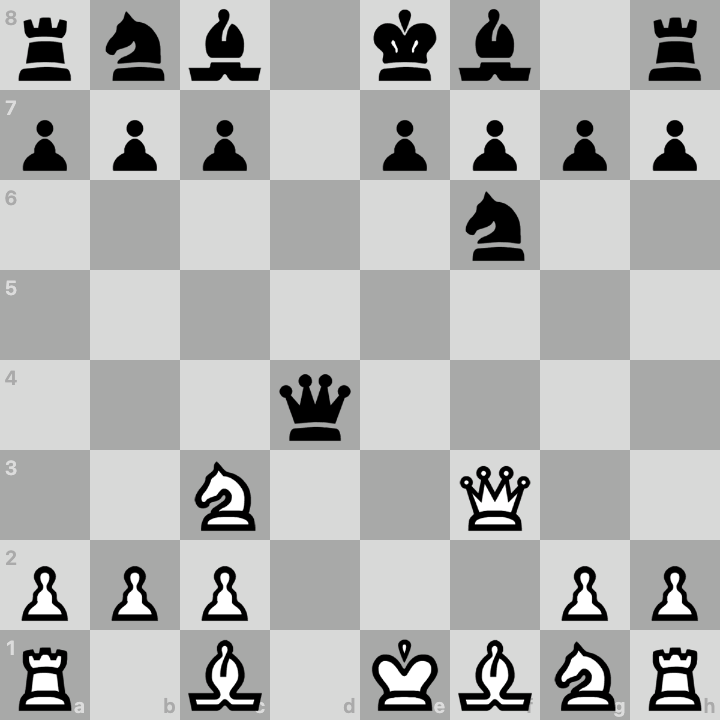
My favourite white opening is the Queen’s Pawn Opening: Blackmar-Diemer, Ryder Gambit, which immediately sacrifices two central pawns while everyone else is fighting to capture the centre and protect those central pawns. I’ve seen strong chess opponents take a deep breath because it’s a very unusual and underplayed opening. In return, White gets a massive advantage in the opening and can put real strategic pressure on Black.
Life is the same. The obvious, direct path is usually crowded, and anticipated. The irregular path is slower and less impressive in the moment, but it is often the one that actually gets you somewhere.
Risk-taking shrinks when you have something to lose
This was the hardest lesson to learn, because it is the most subtle. At the start, when I had nothing on the line, I played bold chess. I tried things, I sacrificed, I went for it. But the more I improved - the more I had invested - the more conservative I became. I started playing to protect what I had built instead of playing to win.
That is true in life too. The more you have, the more you have to lose, and the more tempting it becomes to play it safe. But playing it safe is how you slowly give the game away.
Still, not all of it is a mistake. Some of this conservatism is natural, and it is worth accepting. As we age and build a family, a network, and some wealth, we genuinely have more to lose - so becoming more careful than we were when we were young is just a natural part of life. The skill is not to fight that instinct, but to tell the difference between protecting what matters and hiding from a game you should still be playing. Protect the first. Keep playing the second.
The game gets fairer as you climb
You would expect the top of any competitive ladder to be the most ruthless place. In chess it is the opposite - the higher you climb, the more honest the game becomes, because the people who cheat do not stay near the top.
I found this out by falling. During one bad week I lost game after game and slid down to around 1450 rating. Because you get matched with players at your own rank, I was suddenly surrounded by people at that exact rating. And I could not climb back out. It was not because they outplayed me. It was because a lot of them were cheating, running bots, and those opponents felt unbeatable - not because they were good, but because they were not really there.
The moment I finally escaped that bracket and returned to a higher rating, the game got easier. Genuinely easier. Fewer people cheat at the top, so the result finally started meaning something again.
The environment you are stuck in can be harder to beat than the actual competition. When the people around you are not playing the same game you are, no amount of skill gets you out. Sometimes the move is not to get better at the game you are in - it is to climb to a level where playing well actually counts.
Proximity is not alignment
The game that taught me the most was one I won - and not in the way I expected. I did not beat my opponent with some brilliant, far better strategy. I won because my opponent lost to themselves.
Their pieces had crowded around their own king so tightly that the king could not move. It could not escape, and it could not defend itself - every square around it was occupied by its own army. But here is the strange part: those pieces that were close enough to strangle the king were not actually protecting the king at all. They were aimed at completely different parts of the board, chasing moves that had nothing to do with their leader.
So the king sat there surrounded and helpless - not because it was under attack, but because the pieces closest to it were busy pointing somewhere else. Their proximity did not help. Their misalignment did the damage. What looked like a fortress was actually a cage the opponent had built for themselves.
That is the lesson I have not stopped thinking about. Proximity is not the same as alignment. You can stand right next to something important - a leader, a goal, a moment - and still be pointed the wrong way. And being close while pointed the wrong way is worse than being far away, because you block the very thing you are meant to protect. The people and the effort closest to what matters do not serve it just by being near it. They have to actually be aimed at it. Otherwise they are not protecting you - they are in your way.
Look at Black’s king, surrounded by its own pieces

Conclusion
I have played many games of chess, and after all of them I am still an average player. That is the honest truth, and I have made peace with it.
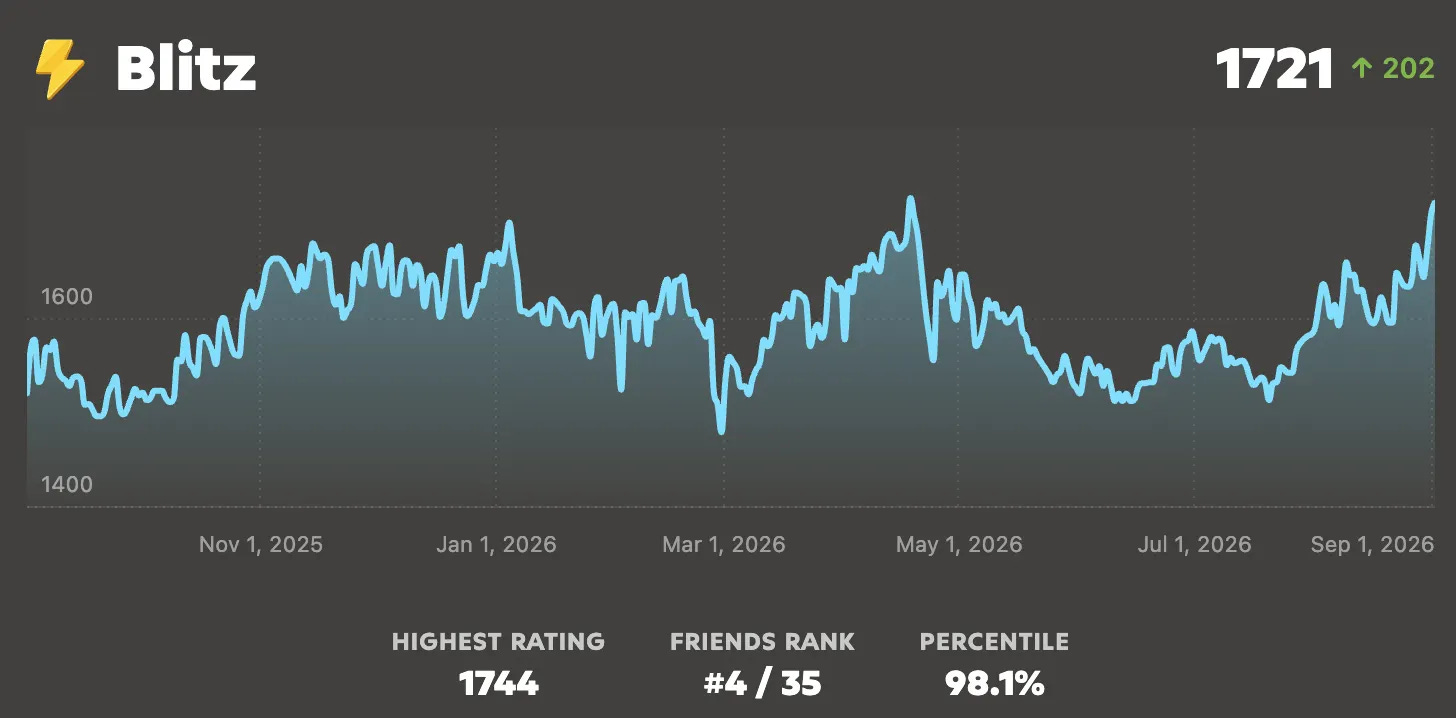
Doing something over and over will make you better at the level you are already at - but it will not lift you out of that level on its own. The real rise comes from mentorship and from deliberately learning what you do not already know. Repetition sharpens what you have. Learning expands what you are capable of.
Which is the quiet point of this whole year. The lessons above look like they are about chess, but none of them are really about the pieces. They are about making decisions when the pressure is on, staying honest about your own state of mind, and knowing when the people closest to you are not actually helping you. A year on the board just made those things impossible to ignore.
Fancy playing a game!? Hit me up and we’ll have a match.