

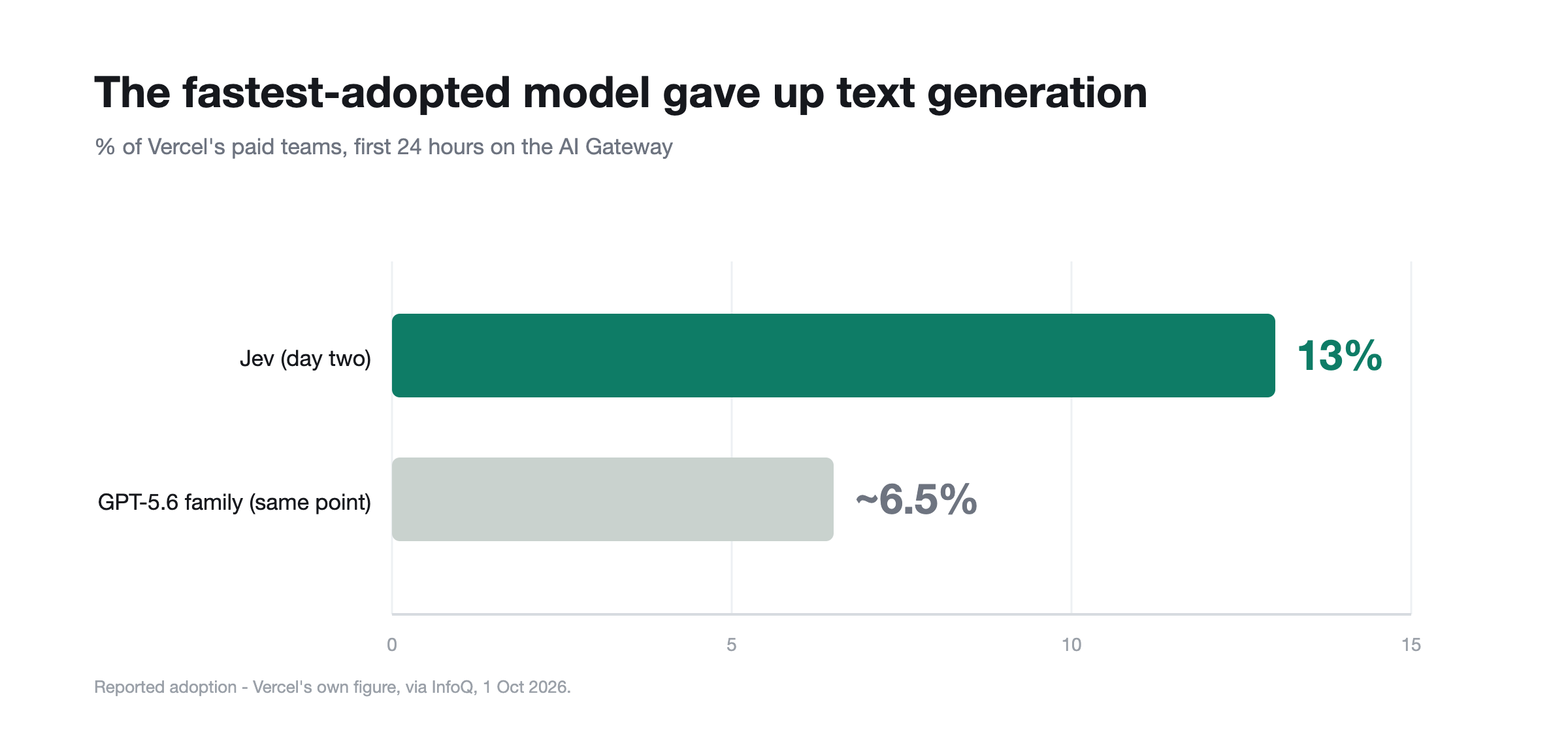
TypeSafe AI came out of stealth on 15 September with a model that cannot write a sentence. Vercel put Jev on its AI Gateway on day two, and within 24 hours it was serving roughly 13% of Vercel’s paid teams, twice the share the GPT-5.6 family had reached at the same point. The fastest-adopted model in that launch was the one that had given up text generation altogether. You hand it a state and a typed question; it hands back a typed answer and a number between 0 and 1, and it stops.

That last line is the whole idea. For eight years, we made software decide things by hiring a writer and hoping it read the brief. Jev is built for the job instead of borrowed from a neighbouring one. It does not draft or chat. Ask whether a ticket is urgent and you get a yes or a no, a probability attached, in about the time a database index takes.
Most of what production AI does is unglamorous. Route this, tag that, score the lead, screen the tool call, escalate or wait. None of it is writing, and all of it went to a writer anyway.
Within days, an open-weight rival was on Hugging Face. Within a fortnight, Cloudflare had shipped a Jev-compatible one. Rivals do not move that fast for a slogan. So what is the thing?
What Jev actually is (and why it calls itself System One)
Jev takes two inputs: a state (text or JSON) and one or more typed questions. It returns a typed answer, a probability for every option it considered, and a confidence score.
Three primitives cover the whole surface. Choice picks one option from up to 255. Score places a set of items on an ordered rubric. Noul returns P(true), a single number between 0 and 1.
The questions stay small on purpose, because you compose them in code. “Rate this pitch” is a bad question. Ask about market size, technical feasibility and differentiation separately, then combine the three with a formula you wrote. They evaluate in parallel, so an extra question barely moves the clock, and retuning the decision is a coefficient edit rather than a prompt rewrite.
The naming is not decoration. “System One” comes from Kahneman’s Thinking, Fast and Slow: the fast, intuitive half, against the slow, deliberate one. Jev is a bet that most software decisions want the fast half. The model itself is named for William Stanley Jevons, and for Jevons paradox: make a decision cheap enough and you will make far more of them.
Two numbers will follow Jev everywhere, and both are TypeSafe’s own: 70 to 500 milliseconds per decision, and $0.042 per million input tokens with the output free. Treat them as claims. Even so, they describe an instrument built for a job nobody thinks of as new. Classification has been running on machines since 1961.
TypeSafe’s published comparison. The Jev figures are vendor-claimed.
Classification is the oldest job in NLP
The first text classifier did not need a neural network. In 1961, researchers were sorting computer-science abstracts with a Naive Bayes model that counted word frequencies. Throw the words in, lose the order, count them: bag-of-words with logistic regression still reaches about 89.9% on IMDb reviews, which is why a sensible practitioner runs it before spending money on anything cleverer.
Learning the words as vectors broke that ceiling. Word2Vec turned tokens into points in space in 2013, LSTMs read them in order, and ULMFiT landed in 2018 at 95.4% on the same set. That is where the job changed shape: you stopped training a classifier and started fine-tuning a language model. BERT made that the default for six years. ModernBERT brought the encoder back to roughly 95% with minimal tuning in 2024.
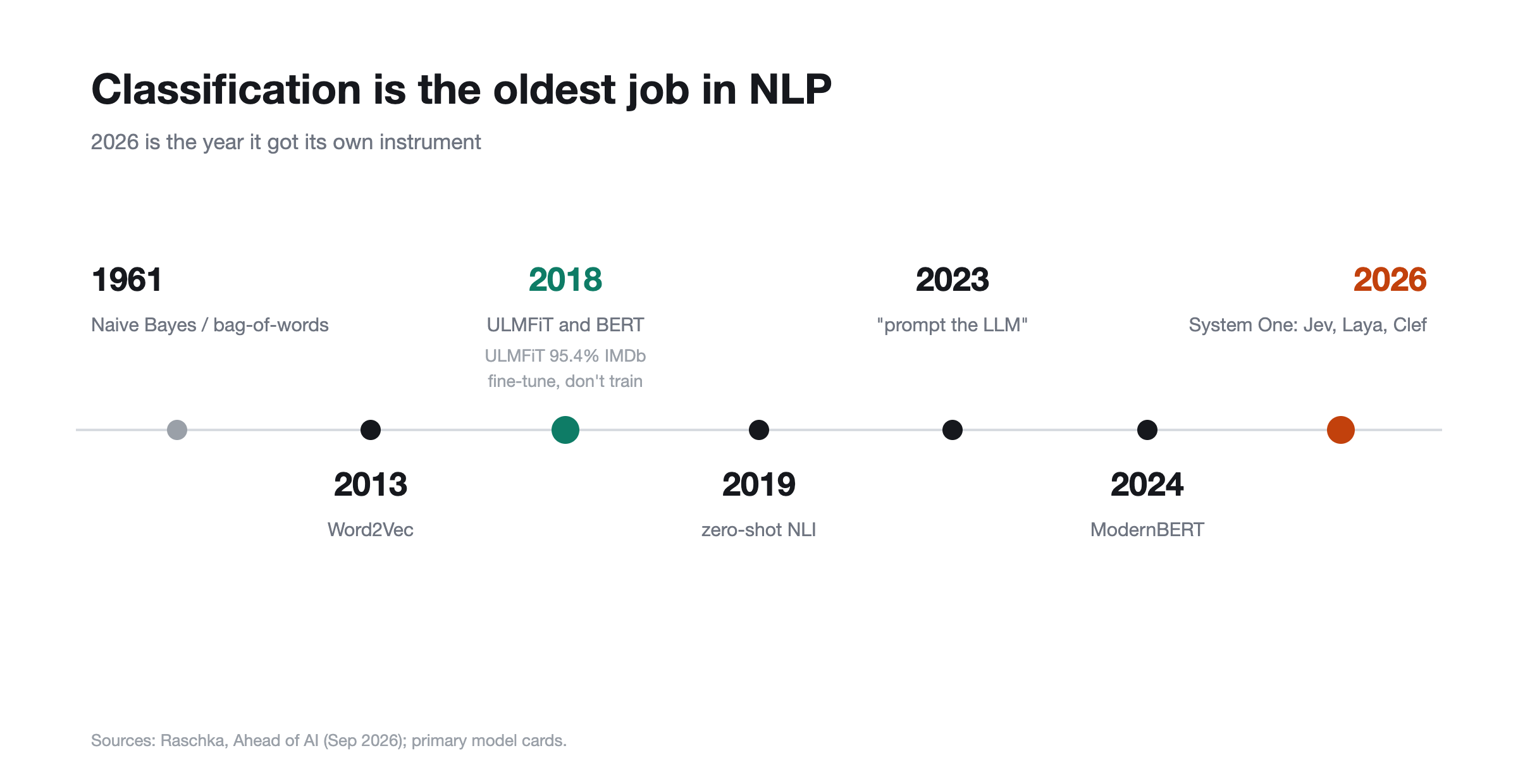
Then, in 2019, someone showed you could classify without training at all. NLI-based zero-shot models took free text and arbitrary labels and returned a probability per label, which is the exact shape Jev exposes today. By 2023 the industry’s answer had collapsed into one instruction: prompt the LLM and ask for JSON. A sequential writer was being paid to guess, and you spent the next three years parsing it.
Classification is the oldest job in NLP. 2026 is the year it got its own instrument.
The feature is not speed. It is calibration.
Laya’s own model card has the illustration. Its English checkpoint, handed a Khmer review, returned an answer at 0.952 confidence with 0.000 accuracy. It was not uncertain. It was certain and wrong, and nothing in the output would have stopped you shipping it.
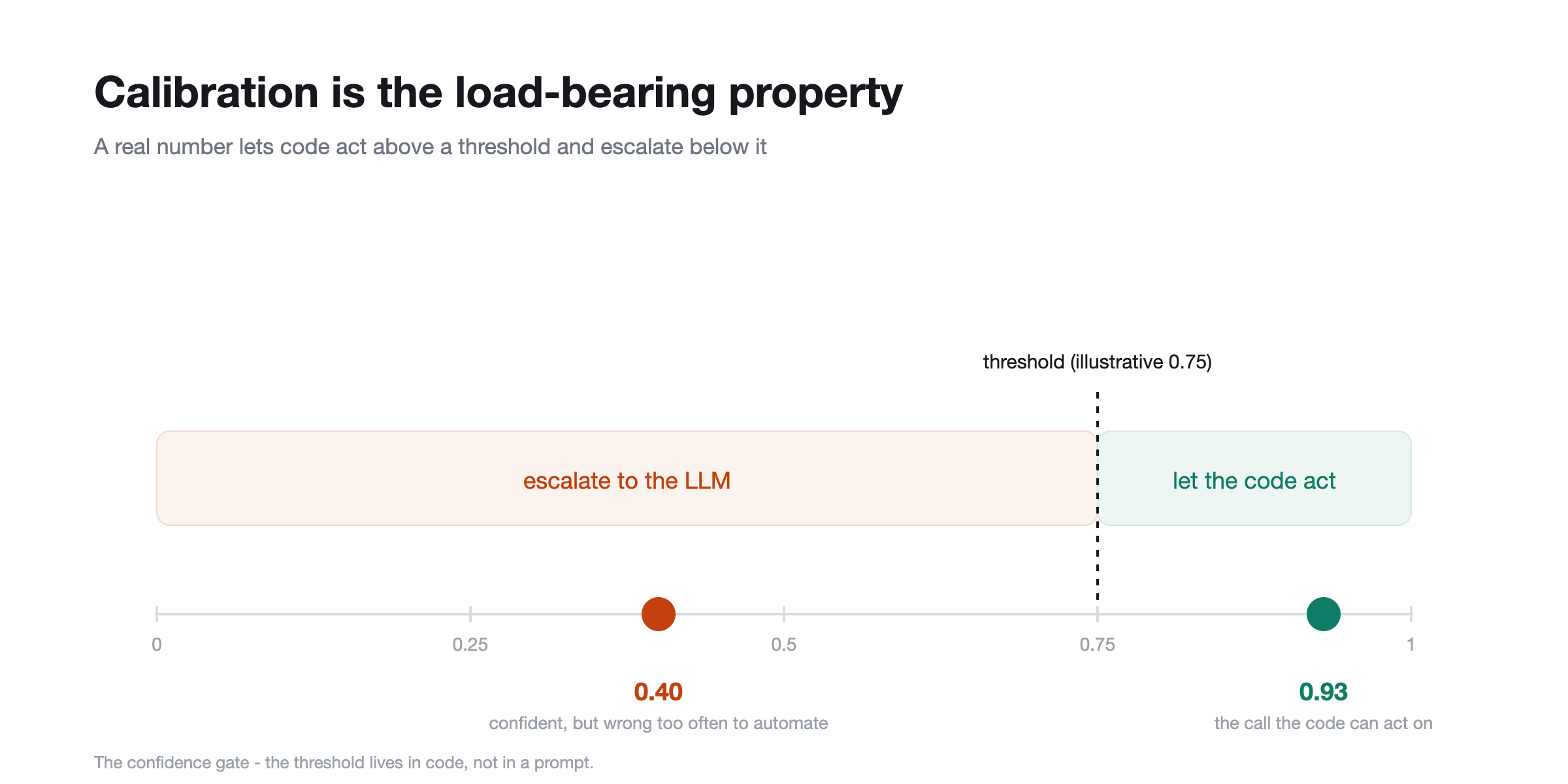
That is the problem a probability solves, and it is why calibration is the load-bearing property rather than accuracy. A model that says 95% without meaning it cannot be automated on, because you cannot find the 5%. A model that returns a real number lets your code do something simple: act above the threshold, escalate below it. The threshold lives in your repository, not in a prompt. You can read it, review it, change it in a pull request, and explain it to an auditor.
So: the feature is not speed. It is calibration. Everything else follows from having it.
Latency then changes where a decision can live. At 70 to 500 milliseconds, the call sits inside the request path, in front of the user, rather than in a background job nobody watches. Type safety removes a failure class outright: because the answer space is fixed before the call, the model cannot emit a malformed field, invent a parameter, or hand an agent a tool call that does not exist. And $0.042 per million input tokens, with output free, makes classifying an entire corpus the boring option rather than the expensive one.
The honest limit matters. A calibrated model hands you the uncertainty. It does not remove it. Jev can still return a valid, wrong answer at 0.9, and TypeSafe’s own documentation says so.
The alternatives, and what they say about the category
Laya is the technical counterpart. Convai shipped it as open weights on an Apache 2.0 licence: a bidirectional encoder that reads everything at once and scores your options without generating a word. Same three primitives as Jev, about 33 milliseconds, installable from PyPI, and free on your own hardware. The catch is in its own benchmark table. The base model scores 0.362 on its typed-decision set, and the 0.766 headline comes after fine-tuning the laya-typed-decisions checkpoint. Its comparison against Jev used Jev’s published third-party numbers rather than a run of both models side by side, so the honest reading is two defensible claims, not a winner.
Cloudflare’s Clef is the drop-in. It speaks Jev’s API, so migrating is a URL change, and it handles images and video where Jev takes text only. It costs roughly six times as much and wants 85GB of VRAM, which is the trade.
Then there is the incumbent’s answer. At DevDay, OpenAI shipped a Decisions API. Fourteen days from one startup’s coinage to a seat inside the platform everyone already runs.
That is the more interesting signal. Jev did not win the category. The interface is becoming the standard, whoever ends up winning it.
System 1 decides, System 2 judges
Jev does not replace the model that writes your code and answers your questions, and that model does not make Jev redundant. The useful question is which one you put where.
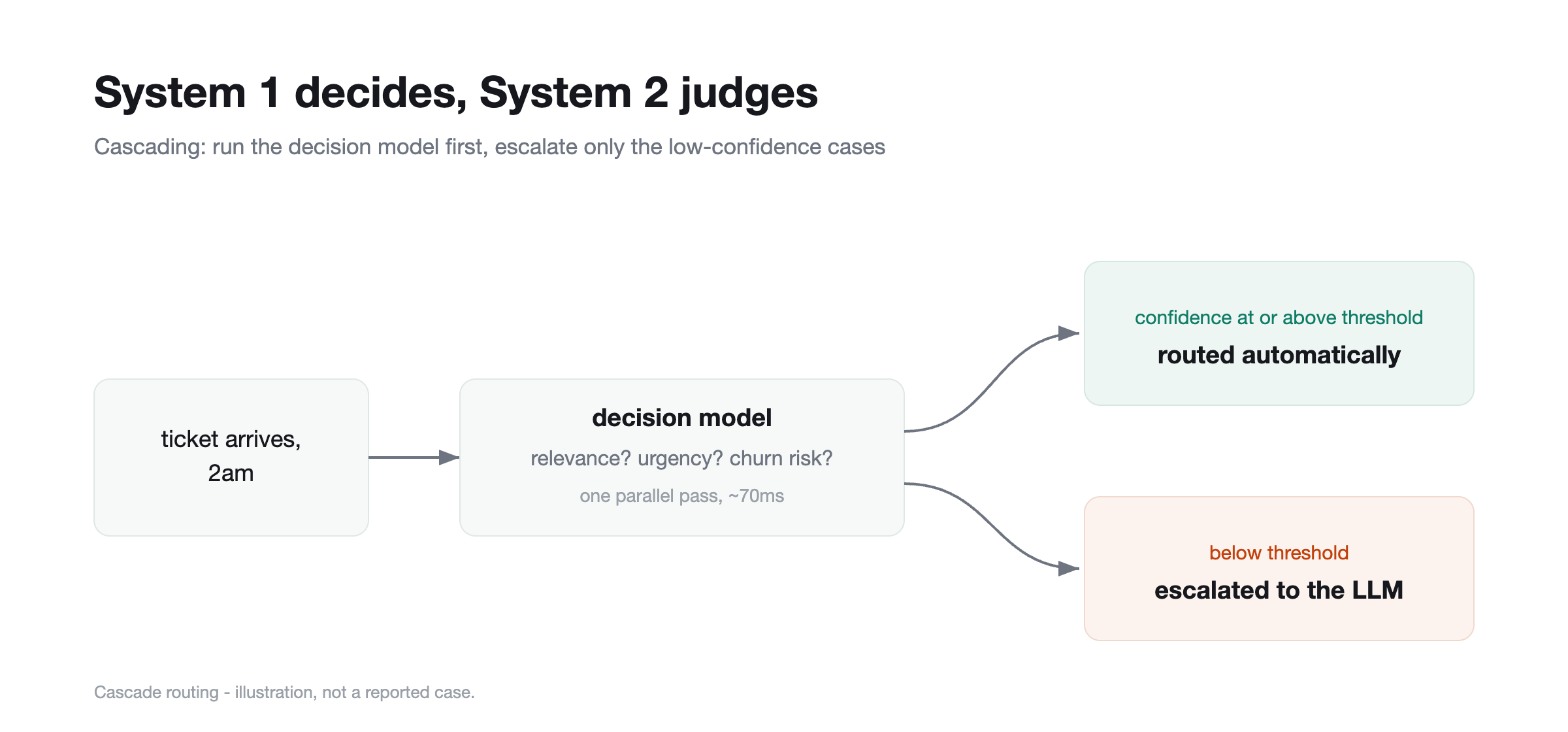
Four patterns are already shipping. Routing: LangChain’s ModelRouterMiddleware inspects the request and picks the tier, so a lookup does not pay reasoning-model rates. Cascading: run the decision model first and escalate only the low-confidence cases, which is the pattern the calibration number exists to enable. Guardrails: screen an agent’s proposed tool calls before they run, and let the uncertain ones wait for a human. Verification: score the model’s output before anything acts on it.
The worked example is support triage. A ticket arrives, and one decision model answers three questions in a single parallel pass: is this relevant, how urgent is it, and is this customer at risk of leaving? High confidence on all three and the ticket routes itself. Low confidence on any one and it goes to the LLM, which writes the reply with the context it needs.
Three things are true at once, and the honest version of this piece says all three. The headline multiples are measured against reasoning LLMs on TypeSafe’s own workflows, and TypeSafe says so itself. “Cannot hallucinate” means it cannot emit an invalid value; it can still be wrong, and 0.9 is not a promise. And the category is a three-horse race already, one of them free to self-host.
At 2am a support ticket arrives. In the 70 milliseconds before a human reads it, a model that cannot write a word has decided it is worth the expensive one’s time, and sent it. Nobody will notice. That is the standard it has to clear, and it clears it in silence. What is arriving now is not a replacement for the models that write. It is the part of the job that was never writing in the first place.
References
TypeSafe AI, Introducing System One Models and Jev, 15 Sep 2026 - typesafe.ai/blog/introducing-system-one-models-and-jev
TypeSafe docs: model page (
jev-1.13.0, pricing, context), System One concepts, jaggedness page - docs.typesafe.ai/modelsInfoQ, TypeSafe AI releases Jev, 1 Oct 2026 (Vercel’s ~13% in 24 hours; LangChain integrations; OpenChamber launch-window medians; Ronacher quote) - infoq.com/news/2026/10/typesafe-ai-jev-released
Sebastian Raschka, Language Models for Text Classification: From Bag-of-Words to Jev, Ahead of AI, 29 Sep 2026 (history beats and IMDb figures) - magazine.sebastianraschka.com/p/classifier-history-and-jev
Convai Innovations, Laya model card (Apache 2.0, benchmarks, Khmer failure) - huggingface.co/convaiinnovations/laya
The Register, Cloudflare’s open-weight Clef models (pricing, VRAM, Jev-compatible API), 1 Oct 2026 - theregister.com
Parallel.ai, Testing Jev (independent, mixed results) - parallel.ai/blog/testing-jev
LangChain, Building a harness with Jev - langchain.com/blog/building-a-harness-with-jev
KDnuggets, What everyone is getting wrong about TypeSafe AI’s Jev - kdnuggets.com/what-everyone-is-getting-wrong-about-typesafe-ais-jev
Distilling System 2 into System 1, arXiv 2407.06023 - arxiv.org/abs/2407.06023
Further reading
From System 1 to System 2 (survey of the dichotomy in LLM research), arXiv 2502.17419 - arxiv.org/abs/2502.17419
Evidence on cascade routing with confidence signals, arXiv 2507.08250 - arxiv.org/abs/2507.08250
Wikipedia, Jev (AI model) - funding, RLCD, and the unpublished details - en.wikipedia.org/wiki/Jev_(AI_model)