

In Part I, we traced the transition from the experimental chaos of 2023 to the “Agentic Enterprise” of 2025. We saw how AI crossed the chasm from individual productivity tools to core infrastructure, reshaping corporate operating models and proving its worth through exponential returns on investment. The narrative has shifted from curiosity to a hard-nosed focus on production, where “integrated independence” is the new benchmark for success.
However, the speed of this transition is underpinned by the raw power of the models themselves. As we enter 2026, the technical landscape has matured into a sophisticated ecosystem where raw intelligence is no longer the sole metric. Instead, the market is defined by reasoning depth, contextual endurance, and a radical realignment of the cost-to-performance ratio.
The Model Wars: Specialisation and Sovereignty
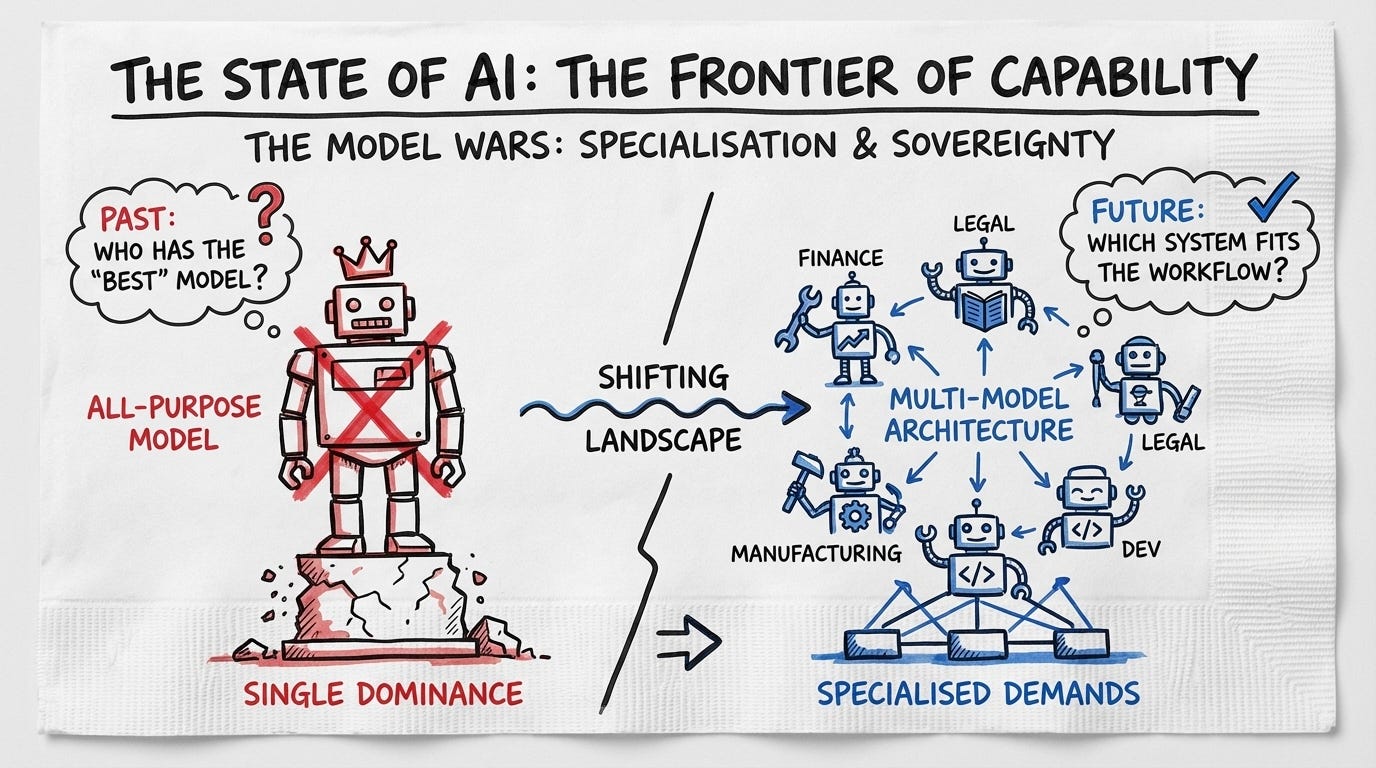
The dominance of a single, all-purpose model has given way to a multi-model architecture. Enterprises no longer ask who has the “best” model, but rather which system fits the specific demands of a workflow.
GPT-5: The Executive Planner
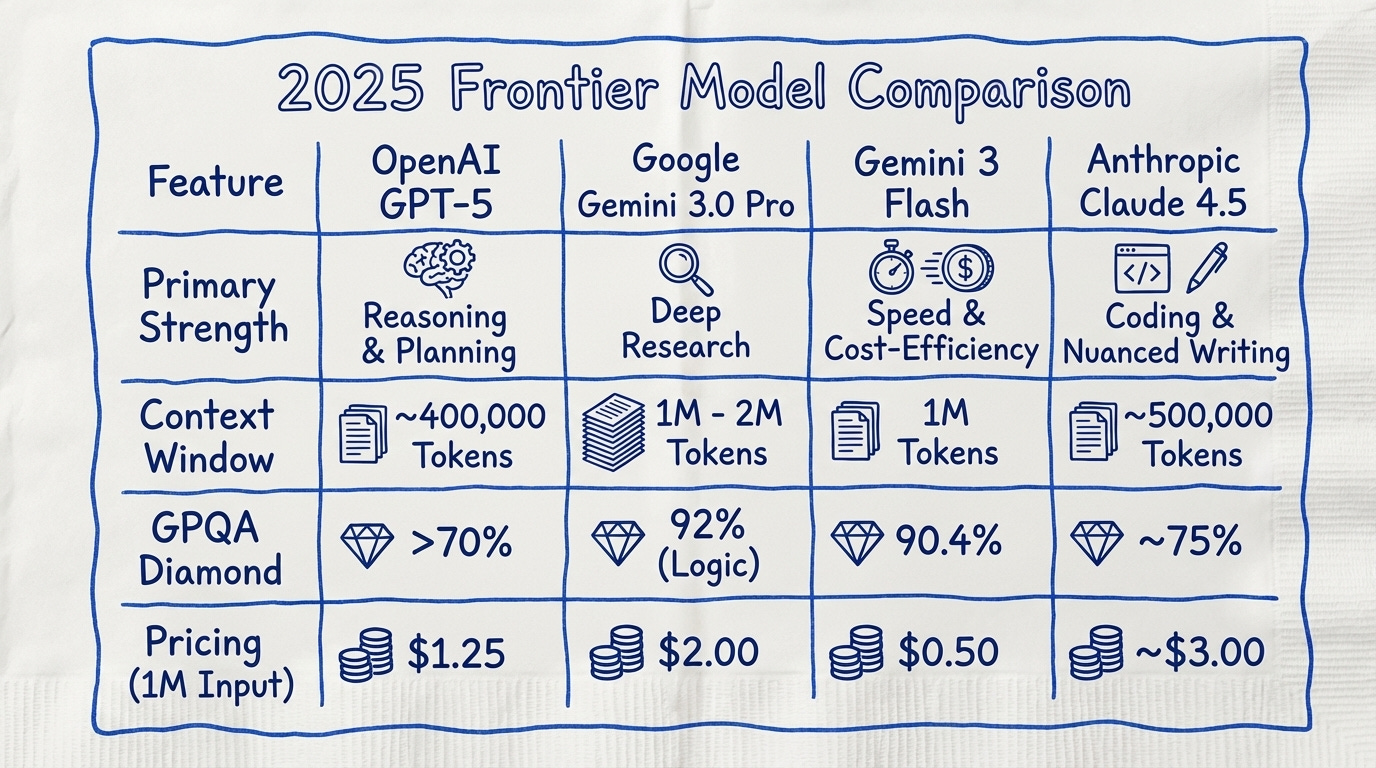
Released in August 2025, GPT-5 moved the industry beyond “next-token prediction” into the realm of outcome planning. It unifies advanced reasoning with multimodal fluidity, using an autonomous routing system to decide when a query requires instant response or a deep “chain-of-thought” process. With a score exceeding 70% on the GPQA Diamond benchmark, it has reached a level of PhD-level scientific reasoning that many thought was a decade away.
Gemini 3.0 Pro: The Deep Researcher
Google’s flagship Pro model remains the undisputed king of context. With a window scaling up to two million tokens, it can ingest entire legal libraries or vast codebase histories without breaking a sweat. Its “Deep Research Agent” capability allows it to plan and execute multi-step synthesis tasks, effectively replacing the data-gathering workflows of junior analysts.
Gemini 3 Flash: The Game Changer
The most significant disruption in late 2025 came not from a larger model, but from Google’s Gemini 3 Flash. In the past, organisations were forced to choose between the high quality of “Pro” models and the low latency of “Flash” variants. Gemini 3 Flash has shattered this trade-off.
It delivers pro-grade reasoning—scoring a staggering 90.4% on GPQA Diamond—at a fraction of the cost ($0.50 per million input tokens). This shift has pushed the entire industry to another level, enabling developers to build responsive, PhD-level intelligent applications that are three times faster than previous generations. It is the first time we have seen frontier intelligence delivered at true scale and speed.
2025 Frontier Model Comparison
The Agentic Shift
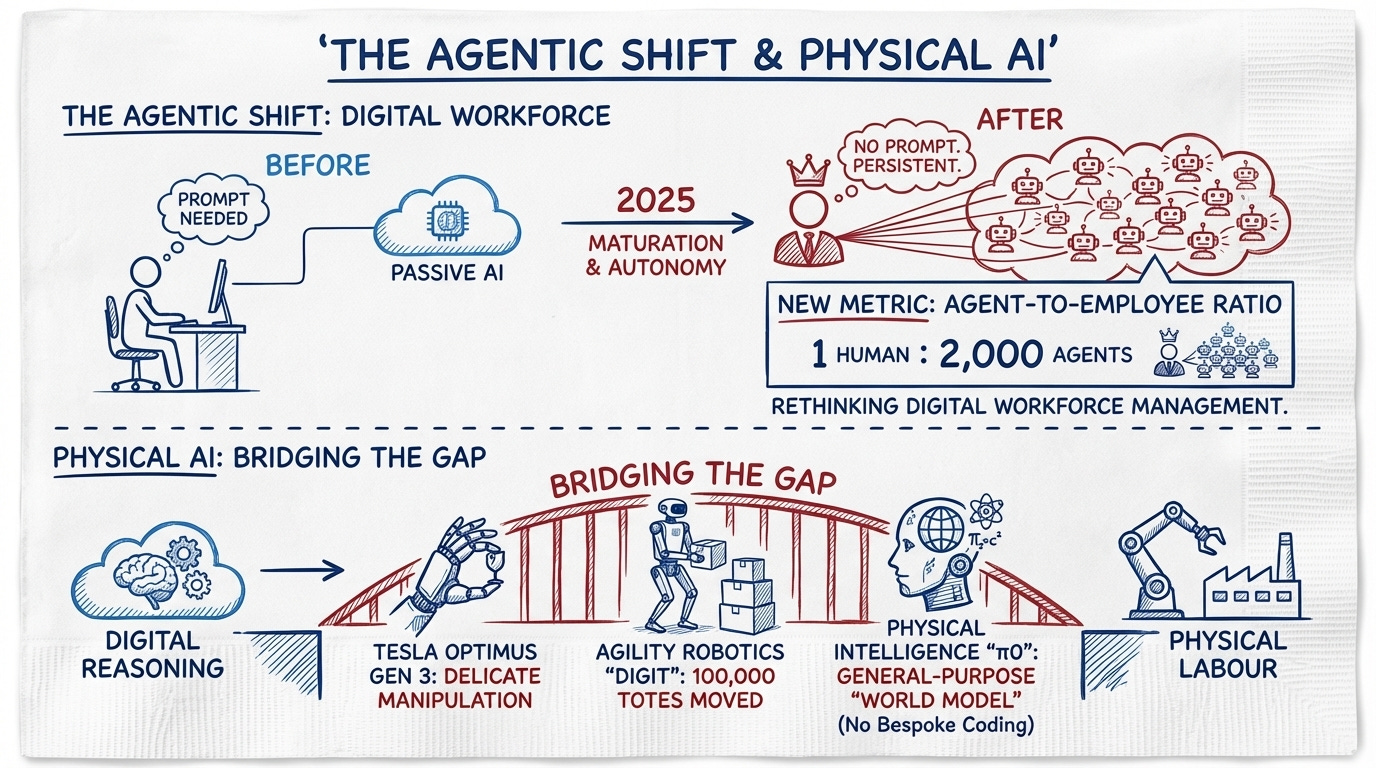
The technical achievement of 2025 is the maturation of Agentic AI. These systems no longer wait for a prompt; they possess autonomy and persistence. We are seeing the rise of a new organisational metric: the Agent-to-Employee Ratio. In hyper-automated sectors, a single human manager might soon oversee a fleet of 2,000 autonomous agents, requiring a total rethink of how we manage digital workforces.
Physical AI: Bridging the Gap
While digital agents dominate offices, physical AI is quietly transforming the floor. Tesla’s Optimus Gen 3 has demonstrated the manual dexterity required for delicate manipulation, while Agility Robotics’ “Digit” has successfully moved over 100,000 totes in commercial logistics environments. The release of “π0” (pi-zero) by Physical Intelligence has furthered this by providing a general-purpose “world model,” allowing robots to understand physics and spatial logic across different hardware types without bespoke coding.
The Rise of Sovereign AI
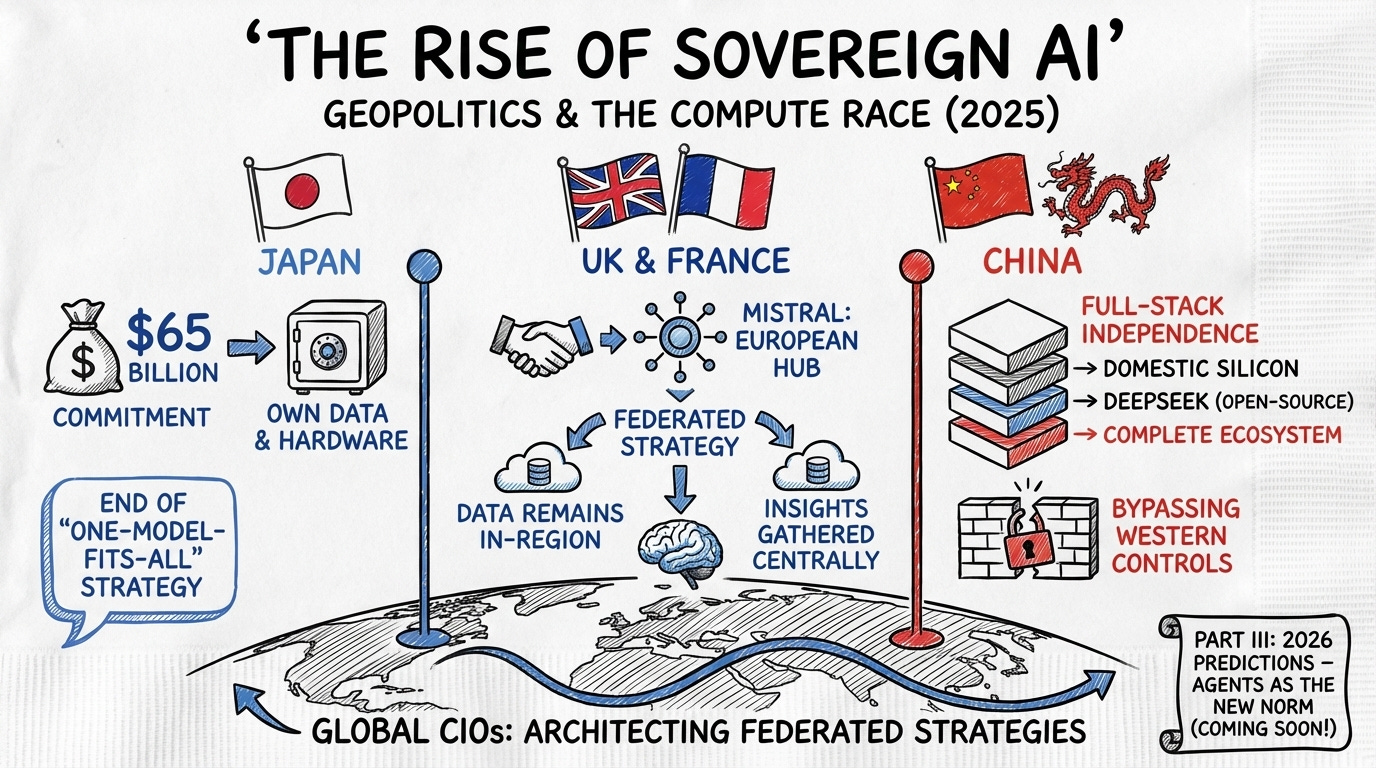
Geopolitics has finally caught up with the compute race. 2025 saw the rise of Sovereign AI, with nations like Japan, the UK, and France investing billions to ensure they own their own data and hardware. Japan’s $65 billion commitment and France’s positioning of Mistral as a European hub signal the end of a ‘one-model-fits-all’ global strategy. China has taken this further by engineering a complete ecosystem that spans from domestic silicon to open-source foundations like DeepSeek. This drive for full-stack independence bypasses Western technical controls. It also offers a template for other nations seeking digital autonomy. Global CIOs are now architecting federated strategies, where data remains in-region while insights are gathered centrally.
The state of AI is no longer a simple race for larger datasets. It is a nuanced, globalised, and deeply integrated system of intelligence that is fundamentally rewriting the rules of the enterprise.
This foundation of capability is merely the starting point. In Part III, I’ll look forward to 2026, sharing my predictions for the next twelve months and exploring how businesses can navigate the strategic risks of a world where agents are the new norm. Look out for the final instalment.
References
Gemini 2.0 model updates: 2.0 Flash, Flash-Lite, Pro Experimental - Google Blog
Gemini 3 Pro tops new AI reliability benchmark, but hallucination ...
How Much Are Gemini 3 Pro and Gemini 3 API in 2025 - GlobalGPT
Gemini 3.0 vs GPT-5.1 vs Claude 4.5 vs Grok 4.1: AI Model Comparison - Clarifai
How GPT-5.2 stacks up against Gemini 3.0 and Claude Opus 4.5 - R&D World
Three-Quarters of Swiss Decision-Makers Plan to Deploy AI Agents in Their Teams
Agentic AI: Storage and ‘the biggest tech refresh in IT history’ | Computer Weekly
AI vs Offshore BPO Logistics: Choosing the Best Approach - Virtualworkforce.ai
Tesla Optimus shows off its newest capability as progress accelerates
Agility Robotics’ Business Breakdown & Founding Story - Contrary Research
Japan’s $135B AI Revolution: Quantum Computing Meets GPUs - Introl
UK government announces billions of pounds of AI investment including Sovereign AI Unit
France Bolsters National AI Strategy With NVIDIA Infrastructure